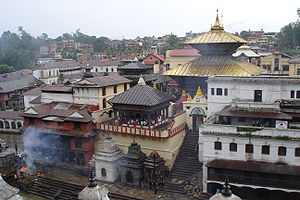
 The Pashupatinath Temple (Nepali: पशुपतिनाथ मन्दिर) is a well known, holy Hindu sanctuary committed to Pashupatinath and is situated on the banks of the Bagmati River 5 kilometers north-east of Kathmandu Valley in the eastern piece of Kathmandu,[1] the capital of Nepal. This sanctuary is viewed as one of the sacrosanct sanctuaries of Hindu confidence .The sanctuary fills in as the seat of the national god, Lord Pashupatinath.This sanctuary complex is on UNESCO World Heritage Sites' rundown Since 1979.[2][3] This "broad Hindu sanctuary region" is a "sprawling gathering of sanctuaries, ashrams, pictures and engravings raised throughout the hundreds of years along the banks of the consecrated Bagmati stream" and is incorporated as one of the seven landmark bunches in UNESCO's assignment of Kathmandu Valley as a social legacy site.[4] One of the significant Festivals of the sanctuary is Maha Shivaratri on which day more than 800,000 lovers visit here.[5]
The twelve Jyotirlinga (in India) are the body and the Jyotirlinga at Pashupatinath in Kathmandu (Nepal) is the head over this body.
The sanctuary is one of the 275 Tamil Paadal Petra Sthalams (Holy Abodes of Shiva) on the landmass. Kotirudra Samhita, Chapter 11 on the Shivalingas of the North, in Shiva Purana says this Shivalinga as the bestower of all desires.
Substance [hide]
1 History
1.1 Legend encompassing the root of the sanctuary
1.1.1 The Cow Legend
1.1.2 The Lichchhavi Legend
1.1.3 The Devalaya Legend
1.1.4 Other convictions
1.1.5 Finding of Shiva Linga at Pashupatinath Temple
2 Temple complex
2.1 Temples and Shrines in the internal yard
2.2 Temples and Shrines in the external complex
3 Main sanctuary design
4 The Deity
5 Priest
5.1 Bhatta
5.2 Bhandaris
6 Entry and Darshan
7 Abhisheka
8 Festivals
9 Controversy of 2009
10 2015 seismic tremor
11 Gallery
12 References
13 External connections
History[edit]
The sanctuary was raised once more in the fifteenth century by Lichhavi King Shupuspa after the past building was devoured by termites.[6] Over time, incalculable further sanctuaries have been raised around this two - storied sanctuary. These incorporate the Vaishnava sanctuary complex with a Ram sanctuary from the fourteenth century and the Guhyeshwari Temple said in an eleventh century composition.
Legend encompassing the starting point of the temple[edit]
Pashupatinath Temple is the most established Hindu sanctuary in Kathmandu. It is not known for certain when Pashupatinath Temple was assembled. In any case, as per Nepal Mahatmaya and Himvatkhanda,[7] the god here increased incredible acclaim there as Pashupati, the Lord of all Pashus, which are living and also non-living creatures. Pashupatinath Temple's presence goes back to 400 B.C. The luxuriously ornamented pagoda houses the consecrated linga or sacred image of Lord Shiva. There are numerous legends portraying in the matter of how the sanctuary of Lord Pashupatinath came to presence here. Some of them are described beneath:-
The Cow Legend[edit]
Legend says that Lord Shiva once appeared as a gazelle and brandished obscure in the woods on Bagmati waterway's east bank. The divine beings later made up for lost time with him and getting him by the horn, constrained him to resume his awesome shape. The broken horn was venerated as a linga yet after some time it was covered and lost. Hundreds of years after the fact shocked herders discovered one of his dairy animals giving the earth drain. Burrowing profound at the site, he found the awesome linga of Pashupatinath.
The Lichchhavi Legend[edit]
As indicated by Gopalraj Vamsavali, the most established ever annal in Nepal, this sanctuary was worked by Supuspa Deva, a Lichchhavi King, who as per the stone engraving raised by Jayadeva 11 in the patio of Pashupatinath in 753 AD, happened to be the ruler 39 eras before Manadeva (464-505 AD).
The Devalaya Legend[edit]
Another account expresses that Pashupatinath Temple was as Linga formed Devalaya before Supuspa Deva developed a five story sanctuary of Pashupatinath in this place. As the time passed, the requirement for repairing and revamping this sanctuary emerged. It is learnt that this sanctuary was reproduced by a medieval King named Shivadeva (1099-1126 AD). It was redesigned by Ananta Malla adding a rooftop to it.[8][9] Thousands of explorers from everywhere throughout the world come to pay praise to this sanctuary, that is otherwise called 'The Temple of Living Beings'.
Other beliefs[edit]
There are a few complex stories including the causes of Pashupatinath. One story goes, in a nutshell, that Shiva and Parvati went to the Kathmandu Valley and rested by the Bagmati while on a trip. Shiva was so inspired by its magnificence and the encompassing timberland that he and Parvati changed themselves into deer and strolled into the woodland. Many spots in the Kathmandu Valley have been recognized as spots where Shiva went amid his time as a deer. Before long, the general population and divine beings started to scan for Shiva. At long last, after different confusions, they discovered him in the woodland, yet he declined to take off. More intricacies resulted, at the end of the day Lord Shiva reported that, since he had lived by the Bagmati stream in a deer's shape, he would now be known as Pashupatinath, Lord of all creatures. It is said that whoever came here and observed the lingam that showed up there would not be renewed as a creature.
Finding of Shiva Linga at Pashupatinath Temple[edit]
It is said that the desire satisfying cow Kamadhenu took protect in a buckle on the Chandravan mountain. Ordinary Kamadhenu went down to the place the lingam was depressed into the dirt and poured her drain on top of the dirt. Following a couple of thousand years a few people saw Kamadhenu pouring milk on that same detect each day, and begun to ponder what that would be. So they expelled the dirt and found the wonderful sparkling lingam and began worshiping it.
Pashupatinath Temple Panorama of the Pashupatinath Temple from the other bank of Bagmati stream, Kathmandu, Nepal.
Sanctuary complex[edit]
The region of Pashupatinath envelops 264 hectares of land including 518 sanctuaries and monuments.[2] Main pagoda style sanctuary is situated in the braced patio inside the complex watched by Semi-Military Nepal Police and Military Force Nepal Army and has a police station alongside living quarter inside. Before the western entryway, there is a colossal statue Nandi bull, in bronze. Alongside numerous sanctuaries and sanctums of both Vaishnav and saiva custom.
Sanctuaries and Shrines in the inward courtyard[edit]
Vasuki Nath emple
Unmatta Bhairav Temple
Surya narayan Temple
Kirti mukh bhairav hallowed place
Budanil kantha hallowed place
Hanuman hallowed place
184 shivaling hallowed place
Sanctuaries and Shrines in the external complex[edit]
Slam mandir
Virat swaroop sanctuary
12 jyotirlingha and Pandra Shivalaya
Guhyeshwari Temple
Pashupati sanctuary environment
Fundamental sanctuary architecture[edit]
This fundamental sanctuary is worked in the Nepalese pagoda style of engineering. Every one of the components of pagoda style are established here like cubic developments, delightfully cut wooden rafters on which they rest (tundal). The two level rooftops are of copper with gold covering. The sanctuary dwells on a square base stage with a tallness of 23m 7 cm from base to apex. It has four primary entryways, all secured with silver sheets. This sanctuary has a gold zenith (Gajur).Inside are two Garbhagrihas, external and inner.The internal garbhagriha or sanctum sanctorum is the place the icon is set and external sanctum is an open passage like space.
The Deity[edit]
The sacro sanctum, or the principle symbol is a stone Mukhalinga with a silver yoni base bound with the silver serpent.The lingam is one meter high and has confronted in four directions.These faces speak to different parts of Shiva; Sadyojata (otherwise called Barun), Vamdeva (otherwise called Ardha Nareshwor), Tatpurusha, Aghor and Ishana (imaginative).Facing West, North, East, South and Zenith separately speaking to five essential components to be specific earth, water, air, light and ether.[10] Each face has small projecting hands holding rudraksha mala on right hand and a kamandalu on the other.Unlike other Shiva lingams in India and Nepal this Pashupati Shiva lingam is constantly Dressed in its brilliant vastra aside from amid abhishakam, so pouring milk and Ganga Jal is just conceivable amid abhishakam through the primary clerics.
Priest[edit]
Raghavendra Bhat (right) and Girish Bhatt in conventional 4-5 kg overwhelming Priestly garb[11] of Pashupatinath Temple
The extraordinary component of this sanctuary is that exclusive 4 ministers can touch the symbol. Day by day customs of Pashupatinath are done by two arrangements of clerics ; one being the Bhatt ministers and other Bhandari. Bhatta or Bhatt are the person who plays out the every day custom and can touch the lingam, though Bhadaris are the assistant and sanctuary guardian ministers who are not fit the bill to perform pooja ceremonies or to touch the god.
Bhatta[edit]
Bhatta likewise spelt as Bhattare very instructed Vedic Dravida Brahmin Scholars from Karnataka. Not at all like other Hindu sanctuaries, brotherhood of Pashupatinath is not innate. Clerics are chosen from a gathering of researchers taught by Shri Shankaracharya Dakshinamnaya Peeth Sringeri on Rig Vedic Recitation, started in Pashupata Yoga by Kashi Math,Shiva Āgama and took in Recitation of Samaveda from Haridwar.After qualifying and satisfying each one of those criteria they will be chosen for Priesthood by Raj Guru of Pashupatinath Temple experiencing strict examination on Vedas and Shiva Agamas and after that the qualifies are sent to Kathmandu for performing Puja and Daily Worship of Lord Shri Pashupatinath This convention is accounted for to have begun by the demand of Adi Shankaracharya in the eighth century, who looked to bind together the distinctive conditions of Bharatam (Unified India) by empowering social trade. This strategy is likewise followed in different sanctuaries around Bharata-varsa which were purified by Adi Shankaracharya.
The one of a kind element of this sanctuary is that exclusive 4 Bhatta clerics can touch the god. Current Bhatt ministers of the sanctuary are;
Ganesh Bhat (fifteenth head minister of the Pashupatinath Temple otherwise known as Mool Bhat) from Udupi.[11]
Slam Karanth Bhat


No comments:
Post a Comment