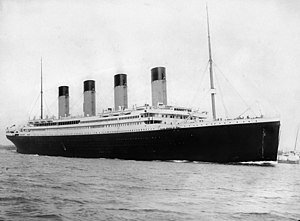
 RMS Titanic (/taɪˈtænɪk/) was a British traveler liner that sank in the North Atlantic Ocean in the early morning of 15 April 1912, in the wake of slamming into an ice shelf amid her first journey from Southampton to New York City. Of the evaluated 2,224 travelers and group on board, more than 1,500 kicked the bucket, making it one of the deadliest business peacetime oceanic fiascos in present day history. The biggest ship above water at the time it entered benefit, the RMS Titanic was the second of three Olympic-class sea liners worked by the White Star Line, and was worked by the Harland and Wolff shipyard in Belfast. Thomas Andrews, her planner, passed on in the debacle.
 Under the order of Edward Smith, who ran down with the ship, Titanic conveyed a portion of the wealthiest individuals on the planet, and in addition several exiled people from Great Britain and Ireland, Scandinavia and somewhere else all through Europe looking for another life in North America. The top notch convenience was intended to be the apex of solace and extravagance, with an on-board exercise room, swimming pool, libraries, high-class eateries and rich lodges. A powerful radiotelegraph transmitter was accessible for sending traveler "marconigrams" and for the ship's operational utilize. Albeit Titanic had propelled wellbeing elements, for example, watertight compartments and remotely actuated watertight entryways, there were insufficient rafts to oblige those on board, because of obsolete sea security directions. Titanic just conveyed enough rafts for 1,178 individuals—marginally the greater part of the number on board, and 33% of her aggregate limit.
In the wake of leaving Southampton on 10 April 1912, Titanic called at Cherbourg in France and Queenstown (now Cobh) in Ireland before traveling west to New York.[2] On 14 April, four days into the intersection and around 375 miles (600 km) south of Newfoundland, she hit an ice shelf at 11:40 p.m. ship's opportunity. The crash brought on the ship's body plates to clasp inwards along her starboard (right) side and opened five of her sixteen watertight compartments to the ocean; she could just survive four flooding. In the interim, travelers and some group individuals were cleared in rafts, a hefty portion of which were propelled just mostly stacked. A lopsided number of men were left on board in view of a "ladies and kids first" convention for stacking lifeboats.[3] At 2:20 a.m., she broke separated and foundered—with well more than one thousand individuals still on board. Just shy of two hours after Titanic sank, the Cunard liner RMS Carpathia touched base at the scene, where she brought on board an expected 705 survivors.
The fiasco was welcomed with overall stun and shock at the gigantic death toll and the administrative and operational disappointments that had prompted it. Open request in Britain and the United States prompted real upgrades in sea wellbeing. One of their most imperative heritages was the foundation in 1914 of the International Convention for the Safety of Life at Sea (SOLAS), which still oversees oceanic wellbeing today. Also, a few new remote directions were passed the world over with an end goal to gain from the numerous stumbles in remote interchanges—which could have spared numerous more passengers.[4]
The disaster area of Titanic, first found more than 70 years after the sinking, stays on the seabed, part in two and step by step crumbling at a profundity of 12,415 feet (3,784 m). Since her revelation in 1985, a great many curios have been recouped and put in plain view at historical centers the world over. Titanic has turned out to be a standout amongst the most well known ships ever; her memory is kept alive by various works of pop culture, including books, people melodies, movies, displays, and dedications. Titanic is the second biggest sea liner wreck on the planet, just beaten by her sister HMHS ''Britannic'', the biggest at any point sunk.
Substance [show]
Foundation
The name Titanic was gotten from Greek mythology and implied enormous. Worked in Belfast, Ireland, in the United Kingdom of Great Britain and Ireland (as it was then known), the RMS Titanic was the second of the three Olympic-class sea liners—the first was the RMS Olympic and the third was the HMHS Britannic.[5] They were by a long shot the biggest vessels of the British transportation organization White Star Line's armada, which included 29 steamers and tenders in 1912.[6] The three boats had their beginning in a discourse in mid-1907 between the White Star Line's executive, J. Bruce Ismay, and the American agent J. P. Morgan, who controlled the White Star Line's parent organization, the International Mercantile Marine Co. (IMM).
The White Star Line confronted an expanding challenge from its fundamental adversaries Cunard, which had as of late propelled the Lusitania and the Mauretania—the speediest traveler transports then in administration—and the German lines Hamburg America and Norddeutscher Lloyd. Ismay liked to contend on size instead of speed and proposed to commission another class of liners that would be bigger than anything that had gone before and in addition being the last word in solace and luxury.[7] The organization looked for an overhaul in their armada principally in light of the Cunard goliaths additionally to supplant their most established match of traveler ships still in administration, being the SS Teutonic of 1889 and SS Majestic of 1890. Teutonic was supplanted by Olympic while Majestic was supplanted by Titanic. Lofty would be brought over into her old spot on White Star's New York benefit after Titanic's loss.[8]
The boats were built by the Belfast shipbuilders Harland and Wolff, who had a since quite a while ago settled association with the White Star Line going back to 1867.[9] Harland and Wolff were given a lot of scope in planning ships for the White Star Line; the standard approach was for the last to portray out a general idea which the previous would take away and transform into a ship outline. Fetched contemplations were moderately low on the plan and Harland and Wolff was approved to spend what it required on the boats, in addition to a five percent benefit margin.[9] For the situation of the Olympic-class sends, a cost of £3 million (£250 million in 2015 cash) for the initial two boats was concurred in addition to "additional items to contract" and the typical five percent fee.[10]
Harland and Wolff set their driving creators to work planning the Olympic-class vessels. The plan was regulated by Lord Pirrie, an executive of both Harland and Wolff and the White Star Line; maritime modeler Thomas Andrews, the overseeing executive of Harland and Wolff's outline division; Edward Wilding, Andrews' representative and in charge of computing the ship's plan, dependability and trim; and Alexander Carlisle, the shipyard's main designer and general manager.[11] Carlisle's obligations incorporated the adornments, gear and every broad game plan, including the usage of a productive raft davit design.[a]
On 29 July 1908, Harland and Wolff displayed the drawings to J. Bruce Ismay and other White Star Line administrators. Ismay affirmed the outline and marked three "letters of understanding" after two days, approving the begin of construction.[14] At this point the main ship—which was later to wind up plainly Olympic—had no name, however was alluded to just as "Number 400", as it was Harland and Wolff's four hundredth structure. Titanic depended on a reconsidered form of a similar plan and was given the number 401.[15]
Measurements and format
Titanic in 1912
Titanic was 882 feet 9 inches (269.06 m) long with a greatest broadness of 92 feet 6 inches (28.19 m). Her aggregate stature, measured from the base of the bottom to the highest point of the scaffold, was 104 feet (32 m).[16] She quantified 46,328 gross enroll tons and with a draft of 34 feet 7 inches (10.54 m), she uprooted 52,310 tons.[17]
Every one of the three of the Olympic-class ships had ten decks (barring the highest point of the officers' quarters), eight of which were for traveler utilize. Start to finish, the decks were:
The Boat Deck, on which the rafts were housed. It was from here amid the early hours of 15 April 1912 that Titanic's rafts were brought down into the North Atlantic. The extension and wheelhouse were at the forward end, before the skipper's and officers' quarters. The extension stood 8 feet (2.4 m) over the deck, reaching out to either side so that the ship could be controlled while docking. The wheelhouse stood specifically behind or more the scaffold. The passageway to the First Class Grand Staircase and exercise room were found midships alongside the raised top of the First Class relax, while at the back of the deck were the top of the First Class smoke room and the generally unobtrusive Second Class entrance. The wood-secured deck was separated into four isolated promenades: for officers, First Class travelers, designers, and Second Class travelers individually. Rafts lined the side of the deck with the exception of in the First Class range, where there was a hole so that the view would not be spoiled.[18][19]
A Deck, additionally called the Promenade Deck, stretched out along the whole 546 feet (166 m) length of the superstructure. It was saved solely for First Class travelers and contained First Class lodges, the First Class relax, smoke room, perusing and composing rooms and Palm Court.[18]
B Deck, the Bridge Deck, was the top weight-bearing deck and the highest level of the structure. All the more First Class traveler convenience were situated here with six palatial staterooms (lodges) including their own private promenades. On Titanic, the A La Carte Restaurant and the Café Parisien gave extravagance feasting offices to First Class travelers. Both were controlled by subcontracted cooks and their staff; all were lost in the catastrophe. The Second Class smoking room and passageway corridor were both situated on this deck. The raised forecastle of the ship was forward of the Bridge Deck, obliging Number 1 bring forth (the primary incubate through to the load holds), various bits of hardware and the grapple housings.[b] Aft of the Bridge Deck was the raised Poop Deck, 106 feet (32 m


No comments:
Post a Comment